
Order: Passeriformes | Family: Tityridae | IUCN Status: Least Concern
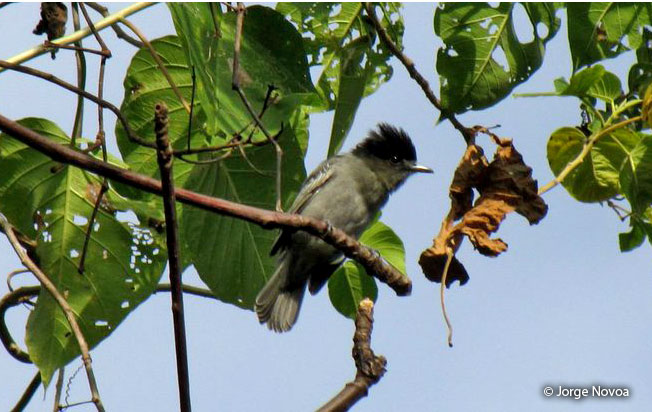
Age: Adult | Sex: Male | Loc. Northwest Peru
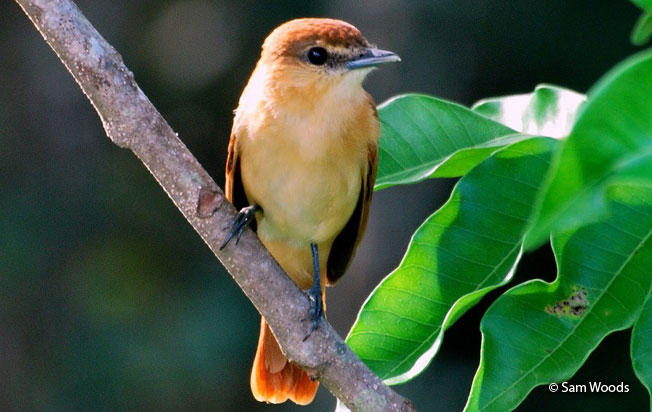
Age: Adult | Sex: Female | Loc. Southwest Ecuador
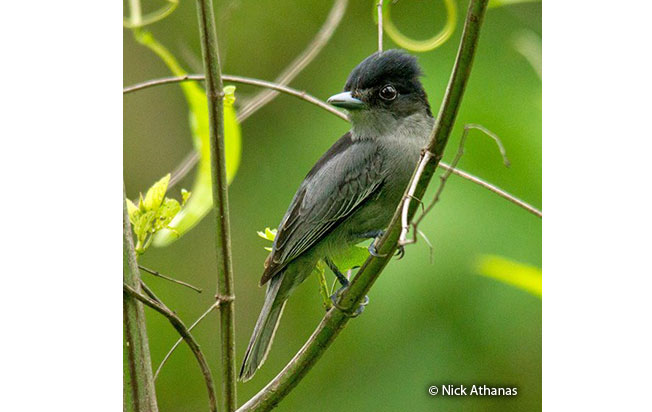
Age: Adult | Sex: Male | Loc. Southwest Ecuador
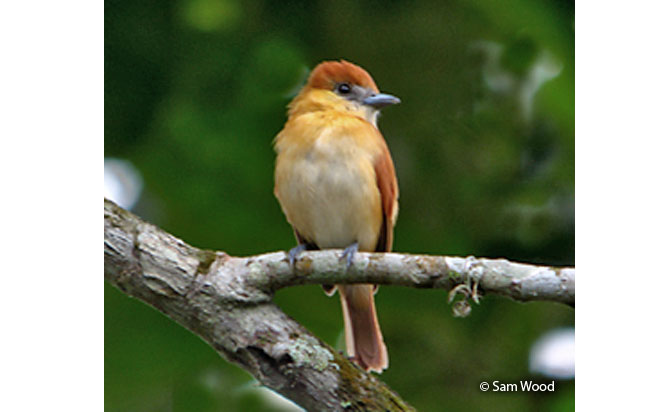
Age: Adult | Sex: Female | Loc. Southwest Ecuador
Identification & Behavior: ~14 cm (5.5 in). The male Slaty Becard has a black cap and dusky-black upperparts and tail. The wing coverts are fringed with whitish. The underparts are gray. It has distinctive pale lores. The female is cinnamon-rufous, warmer on the upperparts, with pale lores. It forages in the canopy and sub-canopy of semi-deciduous forests generally in pairs. It is very similar to the One-colored Becard but is distinguished by a smaller size and pale lores, which are lacking in the One-colored Becard.
Status: The Slaty Becard is uncommon in the western foothills of extreme northwest Peru where it is known to range up to 750 m. It also occurs in Ec.
Name in Spanish: Cabezón Pizarroso.
Sub-species: Slaty Becard (Pachyramphus spodiurus), P. L. Sclater, 1860.
Meaning of Name: Pachyramphus: Gr. pakhus= stout, thick and rhamphos= bill. spodiurus: Gr. spodios= ash-colored ouros= -tailed.
See more of the Family Tityridae 
Distribution Map
 Voice
Voice
VoiceReferences:
-
- Species range based on: Schulenberg, T. S., D. F. Stotz, and L. Rico. 2006. Distribution maps of the birds of Peru, version 1.0. Environment, Culture & Conservation (ECCo). The Field Museum. http://fm2.fieldmuseum.org/uw_test/birdsofperu on 03/01/2016.